Ham Radio & Operations
Ham Radio Meets IT: Running an XLX Reflector Like a Production Service
Glossary — read this first
- D-Star
- A digital voice mode for ham radio. Your voice is encoded into data packets that can be routed over the internet, not just broadcast on a frequency.
- Repeater
- A radio tower at a fixed location that receives on one frequency and retransmits on another, extending range for local operators.
- Hotspot
- A small, low-power gateway (often a Raspberry Pi running Pi-Star) that links your handheld radio to the internet when no repeater is in range.
- Reflector
- An internet “meeting room” — think conference call bridge — where repeaters and hotspots from anywhere can join the same conversation.
- Peanut
- A free iPhone and Android app that lets licensed hams transmit on D-Star reflectors from a phone — no radio or hotspot required. Pick a room, press push-to-talk, and your voice rides the internet to the reflector network.
- AMBEServer
- The voice translator Peanut depends on. The app sends ordinary phone audio; AMBEServer plus USB vocoder dongles compresses and decompresses it in D-Star’s proprietary format in real time — the job a radio’s built-in chip does automatically.
- Zabbix
- Open-source monitoring software that asks your servers questions on a schedule and alerts you when something looks wrong.
Every hobby community has someone who quietly makes sure the lights stay on. The community theater has the person who shows up early to unlock the building and test the microphones. The youth soccer league has the parent who maintains the field schedule and the snack bar cooler. Nobody writes songs about them. The show just happens, week after week, because someone decides the details matter.
Ham radio has that person too. In my case, it turned out to be me — a guy with thirty years of enterprise IT behind him and a callsign (KC4SMH) he earned at an ARRGUS license exam in Kissimmee, Florida back in the summer of 2015. I run four XLX reflectors and an AMBEServer that serve clubs in Orlando, Canada, and Georgia. Hotspots from hams all over the world connect. For the operators who depend on them, these reflectors carry the same weight as a client’s email server: invisible when they work, painfully obvious when they don’t.
This article is about treating a hobby like a production service — test environments, monitoring dashboards, hardware refreshes, the whole discipline. But it’s also about something more universal: the person who showed me a hotspot, sat for my license exam, and built the club that made all of this possible. Sadly, he became a silent key earlier this year, and everything technical in the middle of this piece exists because he cared enough to teach. I’ll come back to that at the end. Stay for it.
How I Got Here
I got my ham license at an ARRGUS exam session in Kissimmee, sitting for both the Technician and General tests in the same afternoon. The volunteer examiners who signed off on it were Steve Butler (NO9S) and Linda Butler (N9NON). Steve was the one who introduced me to digital voice — he showed me a hotspot, explained what a reflector was, and made the whole thing sound less like arcane radio wizardry and more like computer networking with a radio attached.
That single demonstration set everything that followed into motion. Steve showed me a hotspot. I bought a radio. With lots of Steve’s help, I set up a Pi-Star on my desk. I started listening to nets on XLX102B. Eventually I was running reflectors, building Zabbix templates, and refreshing Raspberry Pi hardware in a garage that hits 95°F in July. Spanning the distance from “what’s that cool little box with the radio-active stickers on it?” to “I need a test VM before I push this config change” took over a decade, but the seed was planted in one afternoon by someone who cared about the hobby enough to explain it patiently.
What It Is: Repeaters, Hotspots, and Reflectors
D-Star is Icom’s digital voice mode: your voice gets digitized and routed like data instead of carried as analog FM. That routing is what makes the internet part possible. The glossary above has the definitions; here’s how the pieces connect.
A repeater is club-owned tower hardware that retransmits your signal at higher power — geographic coverage, shared by everyone in range. A hotspot is the personal version: a Raspberry Pi running Pi-Star on your desk that links your handheld to the internet when no repeater is nearby.
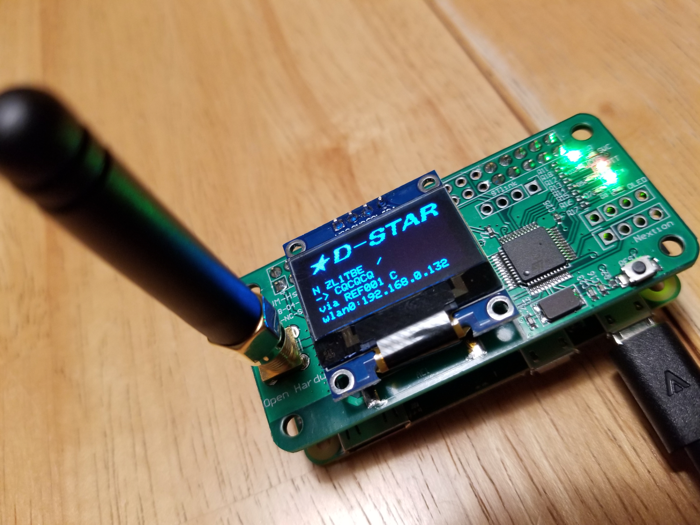
Add a battery and a mobile internet hotspot to Pi-Star, put the whole thing in a cool-looking clear case, and you’ve built a mobile Pi-Star hotspot — the same on-ramp to the reflector network, except now it travels with you.
A reflector is the conference-call bridge where it all meets — a repeater in Orlando, a hotspot in Georgia, and a phone app user in Canada can land on the same module. Licensed operators must register on D-Star and Peanut before keying up. No license, no access.
It’s basically how a walkie-talkie became a group chat.
| Type | Coverage | Hardware / Cost | Who Controls It | Latency | Typical Use |
|---|---|---|---|---|---|
| Repeater | Local / regional (RF range) | Tower site, duplexer, high-power radio — thousands of dollars | Club or group maintains it | Low (direct RF) | Local nets, emergency comms, ragchewing in your county |
| Hotspot | Personal (a few feet of RF to your radio) | Raspberry Pi + MMDVM board — under $200 | You | Low–medium (adds internet hop) | Getting on the air from home without a nearby repeater |
| Reflector | Global (anyone with internet access) | Linux VM or server — moderate, but ongoing uptime responsibility | Whoever runs the server | Medium (internet routing between nodes) | Linking clubs, regions, and modes into shared nets and hangouts |
Signal Flow
The reflector is the conference bridge. Radios dial in through a hotspot; phone users dial in through Peanut and AMBEServer.
How I Run It
Four XLX reflectors run as Ubuntu VMs on Proxmox — three in production (XLX102, XLX103, XLX104) and one (XLXARG) reserved for testing. Pi-Star on my desk bridges my Icom radio into that network. For phone users, Peanut — a free app by David Grootendorst (PA7LIM) — is the other on-ramp: pick a room like XLX102B, press push-to-talk, and your voice rides the internet to the Peanut-USA gateway, then through my gear, then to the reflector.
Phones send ordinary audio, not D-Star packets. AMBEServer on a Pi 5 in the garage is the translator in between: two USB vocoder dongles encode and decode voice in real time across six simultaneous channels. Without it, Peanut users would have audio with no door into the bridge. The AMBEServer didn’t start life as a Raspberry Pi 5 — Sarasota garage summers in the mid-90s taught me that a vocoder workload on a Raspberry Pi without a fan could throttle down, and make Peanut users sound like R2-D2 from Star Wars. The refresh was deliberate: proper cooling, clean OS, and temperature monitoring so I see trouble before the translator silently stops.
I run a dedicated reflector for beta testing updates or configuration changes before pushing them to the production reflectors. That sounds like overkill for amateur radio; it isn’t. A bad config push on Monday evening can break the ARRGUS weekly net at 9:15 AM Tuesday while everything looks fine. XLXARG exists so I can apply changes, verify linking still works, and then promote the same change to XLX102, XLX103, and XLX104. If it can break someone’s Tuesday morning net, it goes through the test VM first — a dress rehearsal, not a gamble on the busiest night of the week.
I watch all of it in Zabbix, the same platform that monitors my home lab. The dashboard covers reflector health on all four VMs, my desk hotspot, AMBEServer on the Pi, and whether the Peanut gateway chain is intact for the rooms where app users land. I don’t control Peanut’s servers, but I can tell when app users are locked out while radio operators are still connected — a different failure, a different fix. Wake me for reflector outages and transcoder failures; don’t wake me for a quiet-afternoon blip on a module nobody’s using. The Tuesday net matters.
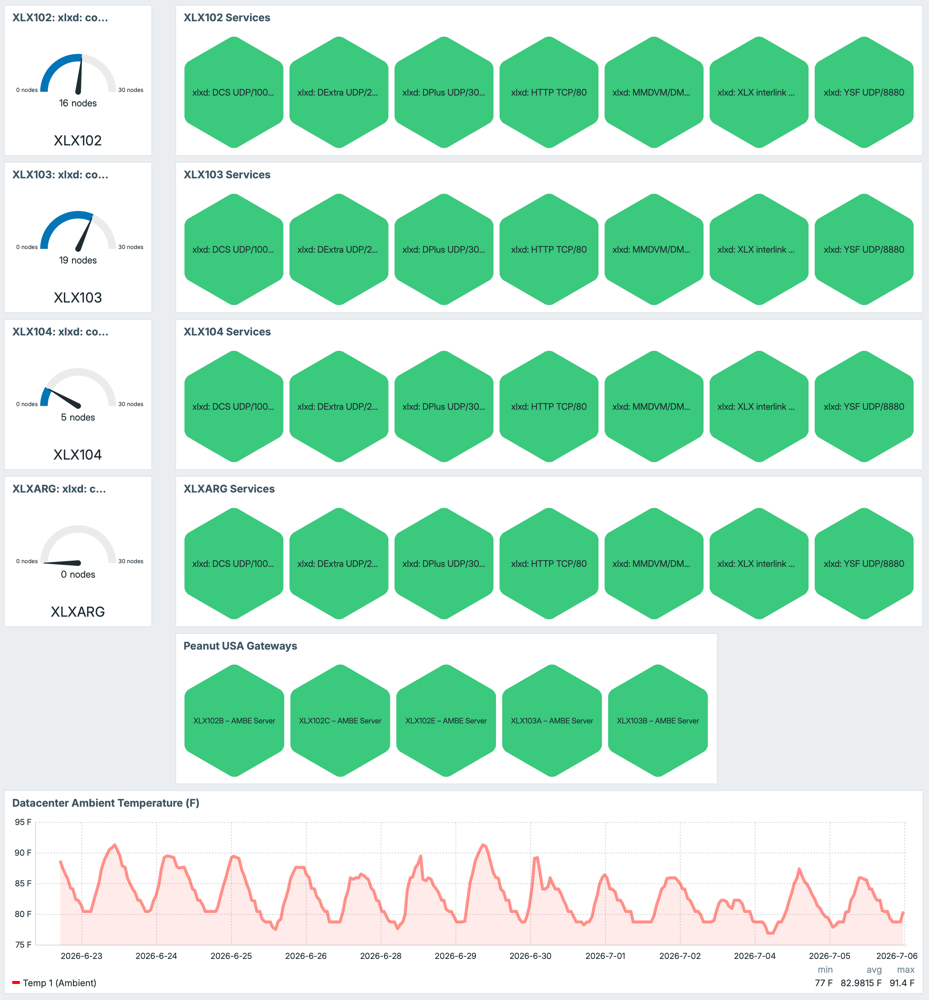
Ham radio operators have a phrase for a reflector nobody’s watching: “it’s probably fine.” I got tired of finding out otherwise 30 minutes before the club’s weekly net.
Lessons for Both Worlds
Running reflectors like a production service taught me things that flow both directions.
From IT to ham: Monitoring discipline isn’t overkill just because the users are volunteers. “It’s probably fine” is not a status page. Test environments aren’t waste — they’re respect for the people who show up every Tuesday expecting the net to work. Alerting should mean something, or people stop listening to it.
From ham to IT: The hobby’s “keep it simple, keep it running” culture is a corrective to enterprise complexity for its own sake. A reflector doesn’t need Kubernetes. It needs xlxd running, ports open, and someone who checks before the net. The best production lesson I’ve taken back to client work is: solve the actual problem, not the impressive one.
But the broader lesson isn’t about radios or servers at all. It’s about volunteer infrastructure and community stewardship. Every club, theater group, youth league, and neighborhood association depends on someone who decided that showing up and keeping the lights on was worth doing — not for recognition, but because the community matters. The technology is just the tool. The commitment is the point.
Passing the Torch
Steve Butler (NO9S) founded ARRGUS — the Amateur Radio Repeater Geezers United Society — and spent years building the repeaters, reflectors, and community that Central Florida hams depend on. He was my examiner, my introduction to digital voice, my mentor, and my friend. He patiently answered my endless questions — the kind a new ham asks when nothing in the manual quite matches what’s actually in front of him. When I lived in Orlando, he helped me work through my radio configuration until I could reliably reach the club’s repeators. Later, with lots of his help, I set up my first Pi-Star hotspot and got it connected to the club’s reflectors. He did the same for many others, one patient session at a time, never making you feel like you were wasting his time. That’s the reason I’m writing this article instead of wondering what a hotspot is. He became a silent key earlier this year, and the loss is still sharp.
Linda Butler (N9NON) has been just as essential behind the scenes. Steve’s ham shack was full of systems he’d built and tended over the years, and Linda was a huge help in identifying what was running, what talked to what, and what couldn’t afford to go dark. She assisted me directly with the migration of some of those systems — work that isn’t glamorous but absolutely has to happen if the reflectors and gateways are going to keep serving the community. She’s carrying the club forward now as president of ARRGUS. The reflectors still run. The Tuesday net still happens at 9:15 Eastern on XLX102B. What Steve built and the community he nurtured didn’t leave when he did — because that’s what good stewardship looks like. Someone else picks up the work and keeps the lights on.
If you’re running similar setups — reflectors, hotspots, monitoring stacks, any of it — I’d like to compare notes. The hobby gets better when the people keeping the reflectors running talk to each other. Drop me a line — admin@xlxreflector.org — and join the Tuesday morning ARRGUS net on XLX102B.
The Bottom Line
Uptime matters even for amateur radio. The reflectors, the monitoring, the test VM, the Pi 5 in the garage with a fan on it — none of that is because I confused a hobby with a job. It’s because real people depend on these reflectors every week, and someone showed me that caring about the details is how you honor the community. The conference call bridge doesn’t create the conversation. It just makes sure everyone who wants to talk can find the room. That’s worth keeping the lights on for.